Brigade response to Solar Facilities in their district.
This report was put together for the Goorambat and District Lobby Group for the purpose of highlighting as many issues as possible with regards to the changing nature of what a brigade must respond to with the introduction of Renewable facilities in their response areas.
This report has been written so that brigades, and other interested parties can look at all the issues and determine their response to their community and in conjunction with CFA.
Note that advise in this report is for “information Purposes only”.
Executive Summary
Overview
The rapid transition toward utility-scale renewable energy, specifically Victoria’s fast-tracked implementation of Solar Facilities and Battery Energy Storage Systems (BESS) is fundamentally changing the landscape for rural farming communities. While these technologies are essential to stabilize the power grid, manage pricing fluctuations, and flatten the evening "duck curve," a critical regulatory vacuum has emerged. There remains a deep divide between top down government policy and the operational, environmental, and social realities of the host communities.
Key Findings
- Regulatory Lag ("The Horse Has Bolted"): Regulatory entities like Vicgrid were established retroactively, leaving them working through terms of reference well after major planning permits had already been approved. Vicgrid was established after numerous projects had already received approvals. Consequently, as reported in The Weekly Times on the 10th of June 2026, 70% of approved renewable energy projects in Victoria sit outside declared Renewable Energy Zones (REZs), driven independently by state and federal funding mechanisms (e.g., State Electricity Commission and Capacity Investment scheme).
- Erosion of Community Trust: The planning process is widely viewed by regional residents as a tokenistic "tick a box" or controlled "drop in session" exercise rather than genuine consultation. The experience of the Goorambat community with the Goorambat East Solar Farm serves as a prime example: developers altered initial commitments regarding panel heights for sheep grazing, mature tree screening, and local infrastructure upgrades without community recourse, leading to deep public resentment and feelings of procedural injustice.
- Unresolved Rural Anxieties: Public opposition is rooted in legitimate concerns regarding the industrialization of prime agricultural land and physical hazards. In local discussions with real estates, when a property has a direct line of sight to the facilities they have estimated a 20% drop in value. (Note this is still to be tested). These include severe line-sagging from transmission infrastructure restricting the use of cropping machinery, and severe visual, sensory, and ecological disruptions.
Critical Fire & Operational Risks
- Systemic Integration Failures: Industry data from overseas indicates that nearly half of all BESS fires occur within the first six months of operation during commissioning. Forensic root-cause analyses from major incidents—including the Victorian Big Battery and Queensland’s Bouldercombe fires—prove that volatile battery chemistry is rarely the initiator; rather, fires are caused by auxiliary equipment failures, coolant leaks, and electrical busbar arcing.
- The Failure of "Controlled Burnouts" in Rural Victoria: While global standards (e.g., NFPA 855) advocate for a passive "controlled burnout" strategy, this approach is fundamentally incompatible with an uncontrolled rural landscape. On extreme weather days (40°C+, low humidity, high winds), unmanaged fuel loads—such as the uncollected loose grass left after late slashing at local facilities—can easily elevate a localized container failure into a catastrophic landscape bushfire.
- Volunteer Operational Overmatch: A BESS fire is a highly toxic, complex HAZMAT incident. Local rural volunteer brigades lack the specialized structural Personal Protective Clothing (PPC), positive-pressure Self-Contained Breathing Apparatus (SCBA or BA), atmospheric monitoring equipment, and advanced decontamination logistics required to safely combat these events.
- Water & Runoff Deficits: Exposure protection requires thousands of litres of continuous water over a 24- to 72-hour window. Rural brigades cannot sustain this via mobile tankers. Furthermore, without mandated on-site containment infrastructure (bunds and lined retention basins), millions of litres of highly toxic chemical runoff threaten to permanently contaminate local soil and regional groundwater tables.
Strategic Recommendations
To bridge the gap between technological deployment and local safety, state regulators and developers must shift from public relations management to meeting strict, non-negotiable community and operational prerequisites:
- Mandate Proactive Transparency & Procedural Fairness: Implement early-stage consultation before site designs are finalized, deploy neutral, locally accessible Community Liaison Officers, and secure upfront, legally binding Decommissioning Bonds to guarantee developers cover full end-of-life land restoration.
- Enforce Formalized Local Benefit Parity: Legally bind long-term economic returns to host communities, including direct local electricity subsidies and neighbourhood benefit dividend payouts to immediate landowners bearing the highest visual impact.
- Rigorous CFA Guideline Compliance: Ensure all facilities exceeding 1MWh strictly adhere to the CFA Design Guidelines and Model Requirements. This includes building mandatory 10-metre mineral-earth perimeter fire breaks, ensuring 15-tonne all-weather vehicle access, installing secure on-site Emergency Information Containers (EICs), and engineering high-flow static water hydrants and unmanned ground monitors.
- Joint Emergency Pre-Planning: Mandate comprehensive, independent Fire Safety Studies (FSS) and Joint Emergency Management Plans (EMP) with local CFA District offices and surrounding brigades prior to permit approval. These plans must include automated telemetry shutdown triggers tied to extreme weather danger ratings and explicit protocols for handing scenes over to specialized industrial salvage operators.
Report on fires for the Goorambat and District Lobby Group in Renewable Energy Facilities in the NE of Victoria.
Introduction:
With the introduction of new Battery energy Storage Systems, (BESS), the landscape is changing for the farming and local communities that are having these facilities located near them.
There is a lot of miss information as well as a complete lack of knowledge on how these facilities will work in the medium to long term.
Based on experience in the USA where some of these facilities are located in high density and high exposure areas, news reports, Youtube videos and also other new feeds where they see the are highlighting the adverse consequences of these facilities.
In the development of these facilities the Federal and State Governments have made it clear in their policies that the transition to “greener” energy will occur with legislation to fast track the implementation of Solar and BESS facilities.
Vicgrid
Vicgrid is a Victorian government entity setup to try and regulate the implementation of renewable energy zones. This entity has been setup post a number of projects that have already been given planning permits and or are already completed. “The horse has already bolted” meaning that this should have been setup some years ago. Vicgrid are still working through their terms of references and also what function they will play in the renewable energy zone in the area of regulation, community consultation and enforcement of regulations and governance.
REZ
As a result of the creation of Vicgrid one of its first tasks along with the Victorian Government was to create a Renewable Energy Zone. Information can be obtained at the Vicgrid website with regards to the Renewable Energy Zone.
Many of the communities along the REZ have felt that this was done with no consultation, no feedback and the easiest path was to place the zone near existing high voltage power lines. In a discussion with Alistair Parker at Goorambat we have received conflicting reports, advice with regards to the overall plan when compared to other areas, i.e. The Protect Dookie & the Goulburn Valley meetings.
While Renewable Energy Zones (REZs) are designed to coordinate transmission and scale, developers are actively proposing and building numerous solar, wind, and storage projects outside these zones. In Victoria, 70% of approved renewable energy projects are located outside the declared REZ areas. (Reported in The Weekly Times on the 10th of June 2026)
State Funding Mechanisms: Initiatives like Victoria’s State Electricity Commission (SEC) and the federal Capacity Investment Scheme (CIS) are actively backing projects, including standalone big batteries, that are not strictly confined to REZs.
Solar Facilities
In looking specifically at the Goorambat East Solar Farm installed by Engie, the planning process started with Neoen. The project was then sold to Engie. As part of the consultation process a number of promises had been made with regards to the height of the panels to allow sheep to graze under the panels, Mature trees to be planted around the facility, complete upgrade of roads and infrastructure around the facility, and a $140,000 Community fund.
Planning changes then occurred without further community consultation and as a result the community feels betrayed and lied to.
While the facility is visually an “eyesore” and degrades from the aesthetics of the local farming landscape it is seen as a passive facility. Risk profiles will be discussed later in this report.
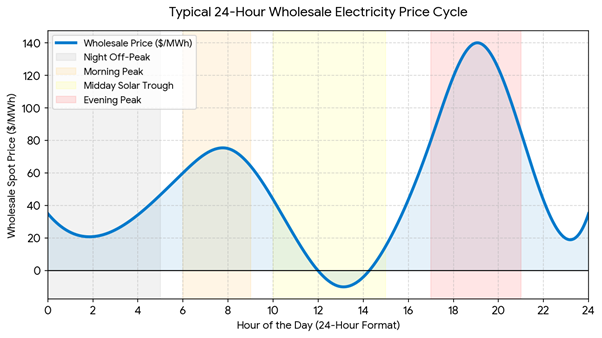
The number of Solar Facilities that are currently active have resulted in surplus electricity production at peak times, forcing facilities to temporarily disconnect from the grid. There has been a consequence that in the middle of the day with full sunshine that the grid is now producing too much power with the generation cost going to zero or even a negative figure whereas a facility must disconnect the power from the grid.
Figure 1.
Battery Facilities
Figure 1. illustrates a typical pricing structure over a 24 hour period, the Duck Curve. To make a solar Facility viable, Solar Companies are now stating that you cannot have a solar facility without a Battery System to reduce the peaks and troughs. To put it in simple terms, energy will be stored during the middle of the day, whether this be from the Grid or from the solar facility and released either in the morning or afternoon peak. This not only reduces the peaks and troughs but also allows for the companies to take advantage of the pricing changes.
Advantages
Rapid Response & Grid Stability: Batteries can inject or absorb power in milliseconds—far faster than traditional thermal power plants—which is crucial for frequency regulation and voltage support.
Renewable Integration: They solve the intermittency problem of solar and wind by storing excess renewable generation and dispatching it during peak demand (like the evening "duck curve").
Peak Saving & Cost Reduction: Utilities can deploy batteries locally to handle demand spikes, avoiding the highly expensive process of building new transmission lines or firing up costly, inefficient "peak only" power plants.
Black Start Capabilities: In the event of a wide-area blackout, grid-scale batteries can provide the necessary surge power to restart conventional power plants without relying on the broader grid.
Disadvantages
High Upfront Costs: Despite falling costs, deploying utility-scale battery infrastructure requires significant capital expenditure.
Severe Temperature Sensitivity: Batteries require a strict, narrow operating range of 20°C to 25°C to maintain optimal performance. Deviations force the system to consume its own stored energy to power internal liquid cooling or HVAC systems, lowering net efficiency.
Underdeveloped Recycling Logistics: Large-scale commercial recycling infrastructure for lithium-based grid batteries is still in its infancy. Disposing of giant deactivated utility packs introduces significant long-term legal liability and environmental risks
Operational Environmental Risks
Hazardous Chemical Spills: Utility-scale BESS installations contain large volumes of chemical electrolytes and liquid coolants (such as ethylene glycol). Any structural breach, severe weather event, or manufacturing defect can leak these hazardous fluids into the local soil and groundwater.
Toxic Air Emissions from Fires: If a BESS experiences thermal runaway, the resulting fire releases highly toxic gases. These include hydrogen fluoride, hydrogen cyanide, carbon monoxide and Polyvinylidene fluoride (PVDF) and polytetrafluoroethylene (PTFE), commonly known as PFAS, which create immediate air quality hazards for nearby ecosystems and communities.
Community Fears
As per the advantages and disadvantages of the Solar Facilities and BESS, (whether with a Solar Facility or stand alone), the fears of the community need to be addressed in the development of these facilities. Without falling into the argument about climate change and the environmental cost of the facilities, renewable facilities are required.
While Battery Energy Storage Systems (BESS) face acute fire-safety anxieties, the broader push for renewable energy facilities—including utility-scale wind farms, solar fields, and high-voltage transmission lines—triggers a distinct set of community fears.
Public opposition often stems from a feeling that rural landscapes are being industrialized to power distant cities, resulting in localized anxieties across several core areas:
1. Landscape Transformation and Eco-Anxiety
- Visual Amenity Destruction: The sheer scale of modern wind turbines (often exceeding 250 metres in height) and sprawling solar arrays radically alters scenic, rural, or coastal vistas, leading to a sense of lost community identity.
- Ecological Disruption: Communities frequently express deep concern over local wildlife impacts, specifically bird and bat collisions with wind turbine blades, and the clearing of native vegetation or habitats for solar fields and access roads.
- Loss of Arable Land: Similar to BESS opposition, farming communities fear that converting prime agricultural land into renewable hubs threatens regional food security, local farming economies, and multi-generational agricultural legacies.
2. Health and Sensory Anxieties
- Wind Turbine Noise and Infrasound: A persistent source of anxiety is the low-frequency noise and sub-audible infrasound generated by rotating wind blades. Some residents fear this causes "Wind Turbine Syndrome," attributing symptoms like sleep disturbance, headaches, and anxiety to nearby turbines.
- Shadow Flicker: The moving shadows cast by wind turbine blades passing before the sun can create a strobe-like effect on nearby homes. Residents fear this causes visual disruption, headaches, and increased stress within their own living spaces. [
- Solar Glare: Neighbours of large-scale solar installations often worry about "glint and glare," fearing that massive fields of glass panels will reflect blinding light into nearby homes or create hazards for local aviation and passing drivers.
- BESS Noise Low frequency noise emitted by BESS installations affecting nearby residences.
3. Economic and Property Devaluation
- Plummeting Property Values: A primary driver of local resistance is the fear that proximity to industrial wind turbines, massive solar fields, or towering transmission lines will make residential properties unsellable or severely reduce their market value.
- Asymmetrical Economic Benefits: Host communities often feel exploited, believing that multinational energy developers reap massive profits while local residents shoulder all the visual and environmental burdens, receiving little more than temporary construction jobs, if any.
4. High-Voltage Transmission Line Fears
- Electromagnetic Fields (EMF): The construction of new, high-voltage overhead transmission lines to connect remote renewables to the grid triggers severe health anxieties. Residents worry about long-term exposure to EMFs, often associating them with elevated cancer risks, despite strict regulatory safety thresholds.
- Bushfire Escalation Risks: In fire-prone regions, communities fear that overhead lines could spark devastating bushfires during extreme weather events. Furthermore, landowners worry that the physical presence of massive transmission towers will restrict aerial firefighting water-bombers from safely defending their properties.
- A directive has been issued by Ausnet that in the Goorambat Stewarton area the lines have now sagged so much that you are unable to operate harvesting equipment near the lines resulting in 400mtr wide areas that cannot be used for crops.
5. Procedural Injustice and Lack of Trust
- Tokenistic Community Consultation: A recurring complaint among regional communities is that developers engage in "tick-a-box" consultation after major project decisions have already been finalized, leaving residents feeling ignored and powerless. This has now been renamed and reformatted to “Drop-in Sessions” rather than “town hall“ meetings so the consultancy company,(s), can control the narrative.
- Override of Local Planning Laws: Public anger intensifies when state or federal governments bypass local municipal councils to fast-track renewable energy approvals, fuelling a perception that urban-centric climate policies are being forced onto rural populations.
Community Expectations
To successfully navigate community resistance, developers and governments must shift from simple "public relations" to meeting clear, non-negotiable community expectations. When a renewable energy facility is in the planning stage, the community expects transparency, respect, and a genuine say in how their local area changes.
Core Community Expectations
· Procedural Fairness: Residents expect their input to genuinely shape the project, rather than being treated as a "tick-a-box" exercise for a predetermined design.
· Proactive Transparency: Communities demand immediate, unedited access to project scopes, environmental impact statements, and financial models without needing to rely on Freedom of Information laws.
· Local Benefit Parity: Host communities expect tangible, long-term economic returns that outweigh the local visual and structural disruption.
· Landscape Protection: Locals expect developers to actively avoid highly productive agricultural land, culturally significant areas, and critical wildlife corridors.
What Should Happen During the Planning Stage
To align with these expectations, developers and regulatory authorities must execute a structured, open planning process.
1. Early-Stage Engagement (Before Designs are Finalized)
· Pre-Design Town Hall meetings: Host open-floor forums before drawing up final site maps to map out local concerns, identifying sensitive boundary lines or prized local vistas.
· Independent Community Liaison Officers: Appoint neutral, locally accessible liaisons who live in the region to act as a direct, unvetted pipeline between residents and project directors.
2. Comprehensive, Independent Impact Assessments
· Micro-Siting Adjustments: Conduct transparent noise, shadow-flicker, and glint-and-glare studies, and show exactly how turbine or solar panel layouts were modified to protect nearby homes.
· Localized Bushfire and HazMat Modelling: Partner with local emergency services (such as the CFA in Victoria) to design explicit, fully funded emergency management plans before applying for planning permits. This should include the local District office and the brigades surrounding the facility as they will be the primary responders to emergencies.
· Baseline Property and Ecological Audits: Fund independent, third-party assessments of surrounding property values and local water tables to establish a baseline for future accountability.
3. Formalised Benefit-Sharing Frameworks
· Direct Electricity Subsidies: Establish community energy credit schemes that directly slash utility bills for all households within a specific radius of the facility.
· Neighbourhood Benefit Agreements: Offer direct financial compensation or annual dividend payouts to immediate neighbours who bear the highest visual impact.
· Legacy Infrastructure Investment: Commit to legally binding legacy funding to upgrade local community assets, such as upgrading secondary rural roads, funding schools, or building community halls.
4. Clear End-of-Life Commitments
· Guaranteed Decommissioning Bonds: Secure upfront, legally binding financial bonds or bank guarantees to ensure the developer—not the local council or landowners—covers the full cost of dismantling the facility and restoring the land to its original state.
Fire
The primary fire risk for Battery Energy Storage Systems (BESS) is cascading thermal runaway, an unstoppable exothermic chain reaction within lithium-ion cells that generates extreme heat and highly flammable gases. Comprehensive data from industry investigations reveals that nearly half of all BESS fires occur within the first six months of operation, during commissioning or initial operations, and are primarily caused by faulty integration, auxiliary hardware failures, or software errors rather than the underlying battery chemistry itself. [1, 2, 3, 4]
Quote from the Lumafield Battery Quality Report;
“The quality of these cells is frequently still a black box, and they fail all too often. It’s estimated that about one in a million batteries will fail, with about 1 in 40 million causing a catastrophic fire. However, given that more than 10 billion battery cells are produced each year, that low per- cell failure rate stacks up.”
While this study did indicate that most Brand name OEM cells showed strong quality indicators, some of the low quality cells showed serious defects. Considering that there are tens of thousand cells in a single BESS “POD” there is the possibility of some manufacturers looking for a “short cut” or cost saving to increase profit.
The Anatomy of BESS Fire Risks
- Thermal Runaway Propagation: If a single cell overheats due to an internal short circuit, mechanical impact, or overcharging, it can ignite neighbouring cells. Without proper separation or active cooling, this triggers a domino effect across modules and entire storage containers. [1, 5, 6, 7, 8]
- Explosive Off-Gassing: Before visible flames appear, failing batteries release a heavy cloud of vaporized electrolyte. This off-gas contains hydrogen, carbon monoxide, hydrogen fluoride, and hydrogen cyanide. If trapped inside an enclosed structure, the high hydrogen content creates a severe deflagration and explosion hazard. [1, 6, 9, 10, 11]
- Reignition Risk: Lithium-ion fires can appear entirely extinguished but reignite hours or even days later. The internal stored chemical energy continuously feeds heat back into the system until the cells are completely discharged, isolated, or cooled to ambient temperatures. [11, 12, 13, 14, 15]
Key Findings from Major BESS Fire Investigations
When official investigation teams and Root Cause Analyses (RCAs) dismantle burned facilities, the findings consistently point away from volatile battery chemistry and toward electronic interfaces and systemic integration flaws. [3, 4]
1. Inverter and Busbar Faults (Not the Cells Themselves) [16]
- The Bouldercombe Incident (Queensland, Australia): The investigation into this Tesla Megapack fire proved that the fire did not start within the battery modules. Instead, a mechanical/electrical fault occurred on the AC side at the power electronics interface with the AC busbar. This initial electrical arc subsequently propagated backward into the battery pack itself. [4, 17]
2. Auxiliary Equipment and Cooling System Leaks
- The Victorian Big Battery Fire (Victoria, Australia): Forensic investigators traced this high-profile blaze back to a coolant line leak. The liquid coolant short-circuited a nearby electronic control unit, generating enough heat to spark a localized fire that quickly cooked the adjacent lithium-ion cells into thermal runaway.
- The Takeaway: The highly praised lithium-ion cells are often the victim, not the initiator, of the fire. [18, 19, 20, 21, 22]
3. Software, Connection, and Monitoring Blind spots
- Delayed Telemetry: Early investigation reports from multiple legacy sites showed that a critical delay in connecting automated telemetry systems during the initial power-up allowed small electrical shorts to go unnoticed by remote operators until thermal runaway was already underway. [18, 23]
4. Post-Incident Cleanups are Logistical Nightmares
- The Otay Mesa Gateway Fire (California, US): This facility burned for nearly two weeks. The subsequent investigation and Environmental Protection Agency (EPA) cleanup process highlighted that the industry lacked established protocols for post-fire handling. Demolition crews had to deal with 2.5 million pounds of fire-damaged batteries, requiring precise submersion in saltwater brine tanks to neutralize residual stranded energy before safe transportation was legally allowed. [13, 24]
Industry Advancements Triggered by Fire Findings
Because of these publicised failures, the BESS engineering space has undergone a massive defensive redesign over the past few years: [3, 25, 26]
- The Shift to LFP: Modern utility-scale developers have rapidly shifted from Nickel-Manganese-Cobalt (NMC) chemistries to Lithium Iron Phosphate (LFP), which boasts a significantly higher thermal runaway threshold and release minimal oxygen if a failure occurs. [25, 27, 28, 29, 30]
- Physical Isolation Over Fire Fighting: Major BESS designs (like updated Tesla Megapacks and Fluence Cubes) are now built as detached outdoor units with highly verified separation spacing. This design philosophy follows UL 9540A testing protocols, allowing a single pod to safely burn itself out without spreading fire to adjacent units, removing the need for firefighters to perform high-risk internal entry. [6, 17, 25, 27, 31]
Reference Material
[1] https://www.sciencedirect.com
[4] https://reneweconomy.com.au
[5] https://www.ausnetservices.com.au
[10] https://ulstercleanenergy.com
[11] https://www.sciencedirect.com
[14] https://www.libertytestandtag.com.au
[15] https://www.flameblock.co.za
[16] https://www.gletscherenergy.com
[19] https://www.batterytechonline.com
[20] https://www.sciencedirect.com
[22] https://www.insurancebusinessmag.com
[23] https://link.springer.com
[25] https://www.ajg.com
[26] https://envirotecmagazine.com
[27] https://ampyr.com.au
[28] https://www.fieldrigifa.co.uk
[29] https://sunlithenergy.com
[30] https://www.sierraclub.org
[31] https://www.iberdrola.com.au
Fighting a fire
Fighting a fire at a Battery Energy Storage System (BESS) requires a defensive tactical approach. It should be noted that the fire should be considered a HAZMAT fire with the appropriate HAZMAT conditions and processes applied.
Because lithium-ion cells provide their own fuel, heat, and oxygen during thermal runaway, traditional internal fire suppression is ineffective. Global guidelines, such as [NFPA 855](https://cleanpower.org/wp-content/uploads/gateway/2024/01/NFPA855_Safety_240111.pdf) standards and [Tesla’s First Responder Industrial Guides] (https://www.tesla.com/firstresponders/industrial-energy-emergency-response-video), dictate that the baseline requirement is a "Controlled Burnout" strategy, allowing the compromised unit to safely consume itself while teams protect surrounding infrastructure.
Where the controlled burn strategy fails for Victoria.
The Controlled Burn strategy works for areas that are controlled. Victoria is known as one of the most fire prone areas in the world. As a result, when we have extreme weather conditions of a 40 Deg C° day, very low humidity, a North/North westerly wind above 20 Klm/hr these conditions are considered extreme with an extreme fire danger rating.
In the farming community, farmers know the risks and stop high risk activity including but not limited to harvestings, welding and grinding and using vehicles in high grass or unharvested crops.
In Victoria, there are no explicit, blanket legislative regulations that automatically force renewable energy facilities to shut down purely on extreme heat days or simply because a fire is approaching. Facilities are legally required to manage bushfire risks and can be forcibly shut down by regulators if they fail to do so. This would be part of an Emergency Management plan which has triggers for shutting equipment down.
If a fire starts in a Renewable Energy facility it is expected by the community that FRV or CFA will respond to these events.
For a small rural fire brigade these conditions may be beyond their operational capability for both equipment and training.
The extreme fire conditions around these facilities would not be fully controllable areas with leaves, grass, wind and other environmental variables contributing to the changing conditions.
The operational, equipment, and structural requirements to manage a BESS fire safely include:
1. Tactical Standoff & Position Controls
· Upwind and Uphill Incident Command: Command posts must be set up windward of the fire. BESS smoke contains lethal concentrations of hydrogen fluoride and carbon monoxide; tracking the smoke plume dictates the evacuation perimeter.
· Strict "No Entry" Protocol: Fire crews are prohibited from opening BESS container doors or service panels. Forcing entry introduces sudden oxygen, sparking a catastrophic deflagration or a physical explosion blast wave.
· 100mtr Isolation Zone: Responders must enforce a minimum 100-metre (approx. 330 feet) hot-zone exclusion perimeter around the burning block for any personnel not donning BA.
2. Specialized First Responder Protection
· BA, (Breathing Apparatus): Standard firefighting turnout gear is physically insufficient against battery chemical gases. This includes Wildfire PPC. Responders require positive-pressure Self-Contained Breathing Apparatus (SCBA) to isolate against hazardous air and gasses.
· Decontamination procedure will need to be fully implemented including local decontamination and a deeper “full” decontamination after the incident.
· Gas Monitoring Logistics: Teams must deploy portable gas detectors around the warm zone to monitor hydrogen accumulation and track when vaporized electrolytes drop below their Lower Flammability Limit.
· Thermal Imaging Cameras (TIC): Crews must use continuous thermal imaging from a safe distance to trace internal heat migration across adjacent battery racks, identifying early-stage propagation.
3. High Volume Water Logistics (Exposure Protection)
· Copious Defensiveness: Water is not used to extinguish the primary fire, as doing so can trigger electrolysis and release extra hydrogen gas. Instead, continuous, high-volume water lines are directed at neighbouring unburned battery pods to keep them cool and block the fire from spreading. Based on the requirement to reduce exposures, which includes the surrounding landscape, environmental factors may require water to be misted or sprayed on the affected battery to keep the fire from spreading due to grass and leaves that may be blown by the weather into the “hot zone”.
· Dedicated On-Site Water Reserves: Facilities must include large on-site static water tanks or dedicated high-flow hydrant rings capable of sustaining defensive cooling operations for a credible worst-case scenario duration (often lasting 24 to 74 hours).
· Unmanned Monitor Nozzles: Responders must use high-capacity pumps to facilitate the use of unmanned ground monitors or deck guns. These tools apply water to cool adjacent pods while keeping emergency personnel well outside the blast and toxic gas radius
· Runoff Containment Infrastructure: Sites must feature engineered retention basins or interceptor bunds. This controls millions of litres of highly contaminated firefighting runoff water, preventing toxic chemical compounds from seeping into regional groundwater tables.
4. Post Incident Requirements (No Overhaul)
· Strict "No Overhaul" Doctrine: Unlike typical structure fires where firefighters rip open walls to check for hidden embers, BESS units must never be overhauled. Striking or moving damaged lithium cells risks triggering a brand-new thermal runaway cycle.
· 24-to-48-Hour Thermal Monitoring: After visible flames cease, the site must be isolated and monitored under an extended watch window because cells retain "stranded energy" and can randomly reignite up to days later. There are a number of conditions that exist after a battery fire which are;
I.Battery condition, unknown. The battery shows no signs of the fire and looks normal. This is the most dangerous as the battery could reignite at any stage and can give the personnel doing any remediation works or overhaul the false impression that the battery is sound.
II.Battery condition, Charged but subjected to heat. This is where the battery shows sign that it has been exposed to heat, therefore will be treated as could possibly go into thermal runaway at any time.
III.Battery condition, Partially damaged. There is a great indication that the battery has suffered damaged including the indication that the over pressure valve has triggered. Again it would be treated as being able to go into thermal runaway at any time.
IV.Battery condition, fully destroyed. Low risk of going into thermal runaway as the battery case has been destroyed with only burnt chemical residue left.
· Specialised HazMat Hand back: The incident command structure must hand the scene directly over to specialized industrial salvage operators equipped with saltwater submersion brine tanks to fully neutralize and stabilize the remaining battery mass.
Reference Material;
[1] [https://www.tesla.com](https://www.tesla.com/firstresponders/industrial-energy-emergency-response-video)
[2] [https://eticaag.com](https://eticaag.com/bess-firefighter-safety-a-first-responder-guide/)
[3] [https://cleanpower.org](https://cleanpower.org/wp-content/uploads/gateway/2024/01/NFPA855_Safety_240111.pdf)
[4] [https://www.engineeringfireprotection.com](https://www.engineeringfireprotection.com/post/fire-suppression-strategies-for-battery-energy-storage-systems-bess-extinguish-or-let-it-burn)
[5] [https://eticaag.com](https://eticaag.com/comprehensive-guide-to-bess-safety-fire-safety/)
[6] [https://www.ausnetservices.com.au](https://www.ausnetservices.com.au/-/media/project/ausnet/corporate-website/files/projects-and-innovation/battery-energy-storage-system-fire-risk-management-fact-sheet.pdf)
[7] [https://www.youtube.com](https://www.youtube.com/watch?v=nffthY0Rvj8&t=32)
[8] [https://www.epa.gov](https://www.epa.gov/electronics-batteries-management/battery-energy-storage-systems-main-considerations-safe)
[9] [https://www.riverdalevfd.org](https://www.riverdalevfd.org/genords/div6/Div6Chap8.pdf)
[10] [https://www.mfs.sa.gov.au](https://www.mfs.sa.gov.au/community-safety/building-and-commercial-fire-safety/guidelines-and-information/fire-safety-position-statement-bess-1.0.pdf)
[11] [https://www.cfa.vic.gov.au](https://www.cfa.vic.gov.au/ArticleDocuments/1933/250604%20-%20CFA%20Guideline%20-%20Fire%20Safety%20Studies%20for%20BESS%20v1.pdf)
[12] [https://modeenergy.com.au](https://modeenergy.com.au/wp-content/uploads/2016/07/Tesla_Battery_Emergency_Response_Guide_English.pdf)
[13] [https://www.energysafe.vic.gov.au](https://www.energysafe.vic.gov.au/industry-guidance/electrical/installations-and-infrastructure/general-duties-solar-farm-owners-and-operators)
Water
As per above, the water used on a BESS during an incident is only for the cooling of the adjacent batteries and exposures. This however does not fully meet the communities’ expectations. As previously listed, in an uncontrolled environment, fire at a BESS may require water to be sprayed on the battery to a) Prevent an explosion or fire if the POD is only venting, b) Spray the POD if there are grass and leaves blowing in the area.
In an example of this the Goorambat East Solar Farm (GESF), had let the grass grow beyond the 100mm limit for the 2025 fire season. It was then cut providing a fire load of grass on the ground that the wind can pick up and blow around.
It is noted that for times outside the Fire Danger Period, (FDP) that the control of grass height is not mandated therefore at the beginning of the season when the grass has grown, the slashing to bring the grass back to 100 mm at the beginning of the FDP’s will result in loose flammable material blowing around the facility.
From the above notes and observations, it is expected that while water may not be required to try and quench the fire it would be used directly on the BESS POD to mitigate the risks.
Commercial BESS facilities should be required to feature engineered containment, such as spill containment bunds, lined retention basins, or filtering ponds to trap 100% of the firewater on-site until it can be tested and pumped out by hazardous waste teams.
During a meeting between RED Fire Engineers, Jennifer Blythe, and Matthew Allen from CFA, it was noted that the CFA did not provide comment on-site water containment for the Mokoan West solar farm planning permit. Ian Raymond from RED Fire Engineers stated that “Runoff from burning BESS is contained as no water is applied directly to a BESS unit”. He stated that water would only be used for exposure protection, rather than extinguishing the fire's point of origin (POD). No action is to be implemented.
CFA’s Role
The CFA have a clear mandate with regards to the preservation and protection of life above all other doctrines.
CFA Head office in Melbourne has now adopted a Standard Operating Procedure, (SOP), for Solar Energy Facilities as per SOP 10.30
It is noted that these procedures had been developed at a local District level, DOP, in response to the large installation of Solar Facilities. It was then adopted as a full SOP after a number of facilities have already been constructed.
What community expects from CFA
Changing the Brigade Risk Profile
Traditionally, the operational focus of many rural CFA brigades has centred on grass and scrub fires, structure fires, motor vehicle accidents, farm incidents and storm emergencies. Brigade equipment, training and operational procedures have evolved around these relatively well-understood hazards.
The introduction of large-scale renewable energy facilities, including Solar Farms, Wind Farms and Battery Energy Storage Systems (BESS), fundamentally changes this operational environment.
These facilities introduce new industrial risks that many volunteer brigades have not previously encountered. In many cases, they become the first responders to incidents involving high-voltage electrical infrastructure, hazardous materials, lithium-ion battery systems and complex industrial assets.
While specialist resources from Fire Rescue Victoria (FRV), CFA specialist advisers or technical support personnel may ultimately attend, it is almost always the local volunteer brigade that arrives first and is required to assess the situation, protect life and make critical operational decisions.
This changing risk profile should be recognised during both the planning approval process and the operational life of every renewable energy facility.
Even with the help of specialist advisers, the community have expressed fears that the help and expertise will take too long to arrive. The guiding principle of letting a battery burn out is seen as unacceptable due to the fear of:
a). There will be toxic smoke and fumes that will cause long term health issues,
b). The fire will escape the facility and into the wider landscape.
There has generally been an expectation from community who are also members to “get in there and hit it hard and fast”.
This is not case as per the CFA’s SOP we are to wait and evaluate. Depending on the scenario the CFA may not even send crews into a facility based on a number of considerations.
This messaging creates a perception of unacceptable risk to the community.
The community expects that the solar companies and or CFA will supply and fund the equipment and training to deal with the fires in the facility.
In a number of community consultations, it was very clear by community members that “These companies are coming into our area, why isn’t CFA forcing them to supply the equipment to fight their fires”.
It is expected that the CFA would have more a legally enforceable recommendations around the solar farms. When the community are told about the CFA only having an advisory role, there is anger and anxiety over the consequences. All community members believe that there needs to be legislative change by the Victorian Parliament.
It would also be expected that CFA would strongly canvas political parties to provide the legislation for them to provide meaningful and enforceable changes to the facilities based on the risk.
What Brigades expect from CFA
There are two different views based on discussions with surrounding CFA Captains and members.
A). Let it burn, we will wait on the outside as we are not equipped or trained to fight the fires. “It is not our responsibility to fight fires in the facilities”.
B). We need the equipment and training to actively fight the fires within the facility.
There are some instances where some brigades are willing to fight Grass and scrub fires in the facility but leave the batteries to FRV HAZMAT crews. This would imply that the brigade would still have to enter the facility to evaluate and consider the brigade strategy or determine what action needs to be taken.
The CFA only has an advisory role. There is no legislation to force companies to accept the recommendations from CFA. It is noted that the Dept of Transport and Planning have accepted the CFA’s recommendation however there is a belief that if the CFA’s recommendations are too restrictive, the Minister or regulators can ignore/overrule the CFA’s recommendation.
In practice there are only two CFA specialist working within the Renewable Energy facility space in Melbourne, (Matt Allen, Specialist Risk and Fire Safety Unit and Jennifer Blyth, Senior Specialist Risk Adviser).
With the number of Renewable Energy Facilities, the time between application and acceptance, the CFA may only have five days to put together a plan and recommendation for the planning application.
In the planning of the facilities there is minimal consultation with CFA and in some cases it’s only because the company has begun its “Community Consultation” that a local brigade knows that there are plans being considered.
It is expected that a brigade should be consulted with regards to their needs and the consequences locally if the facility is built.
This is not happening due to a number of reasons including but not limited to, the time to submit a response to a planning permit, the lack of funds, Government policy and procedures, lack of communication flow between Melbourne H/O to District to Brigades, based on time restrictions and other factors that can influence the overall consultation process.
An example of the need for an individual consultation with a brigade is the proposed facility at Mokoan West by Lightsource BP. During the discussions at the community consultation, it was noted that the invertors and BESS systems are located in the middle of the solar panels. When discussing access to the equipment, Lightsource BP had stated that they will have a road along the length of the solar array for access. When it was mentioned that the area has major drainage issues, a truck may get caught between a burning BESS and an escape route and may get caught due to only two roads with no access points, Lightsource BP felt it was not an issue. The local brigade felt it was an unacceptable risk to their members and will not enter the facility.
As the renewable facilities are being built, it is understood that CFA may not have the funding to supply new or upgraded equipment to a local brigade. When a renewable facility has changed the risk profile for a brigade, then it should be mandated by CFA to the renewable Facility to supply as part of the planning permit to supply the required equipment to the local brigade,(s).
CFA has the ability to look at each brigade/district and through consultation with both the brigade and the facilities determine what is required based on the facility.
It is expected that CFA advocate on behalf of the brigades to direct the renewable energy companies to fund the purchase of the equipment that is required for the protection of their assets.
Funding the Additional Capability
Where a renewable energy development significantly alters the operational risk profile of a local brigade, it is reasonable to expect that the additional capability required to manage those risks should be funded as part of the development.
This is consistent with the long-established principle that those creating additional risk should contribute to the measures necessary to manage that risk.
Developers routinely fund road upgrades, drainage works, environmental offsets and other infrastructure necessary to support their projects. The same principle should apply to emergency response capability.
Planning approvals should therefore include requirements for developers to contribute, where appropriate, to:
· Additional brigade equipment.
· Specialist training.
· Water infrastructure.
· Emergency planning.
· Site familiarisation exercises.
· Communications systems.
· Ongoing capability reviews.
Such contributions would not replace government funding of emergency services. Rather, they would recognise that renewable energy developments introduce new and highly specialised operational risks that extend beyond the traditional capabilities of many volunteer brigades.
Based on the quantity and type of battery chemistry for a typical BESS there are a number of dangerous materials. In the below example for the Mokoan West Solar Facility the bellow table gives an example of what will be onsite once the facility is operational.
Classes and Quantities of Dangerous Goods Stored based on 32 BESS units and 64 invertors.
Class Description Quantity
2.2 R-134a / R-410a 1,000 L
9 Lithium Batteries 900 T
C1 Transformer oils 196,100 L
C1 Diesel 5,000 L
Estimated commodity and quantity based upon similar projects
Personal Protection Clothing. (PPC).
As previously listed where any equipment is “on fire” or in some form of catastrophic event, the event is considered to be a HAZMAT event with the appropriate precautions.
For stations that do not have decontamination facilities this can lead to a situation where the contamination is now being spread further. Best practices are to bag the effected PPC at the site for laundering.
While a preliminary wash down and decontamination can occur on site this is only a temporary solution till full decontamination can be arranged.
This will mean that members will lose their PPC while it is being cleaned at a specialised cleaning service.
For members, especially in summer, that do not have multiple PPC clothing, this may lead to a situation where the brigade may have to come “offline” due to the fact that members do not have spare PPC. CFA have indicated that they can get spare PPC from Melbourne but this takes time. This could mean for some members a full refit of their PPC.
For a number of key members that are likely to respond to an event in a Renewable Energy Facility there would be justification for multiple PPC to be issued to allow for continued operation of the brigade.
Specialised equipment
As a note for brigades there are a number of items that brigades might need based on the profile of the brigade and district;
· Specialised or further Forward Command Vehicles, (FCV). This is based on a brigade need to assess a situation before crews are permitted onsite. This is especially important for single cab trucks where crews could be exposed to fumes in trucks with ROP’s. Where a prolonged fire may be encountered this may need to be onsite for a number of days.
· Trailers and quick fill pumps to facilitate a prolonged attack where required. This may include long lengths of hose, couplings etc. to allow vehicles and equipment to be kept out of the smoke and “hot zone”.
· Breathing Apparatus. BA is available for crews but comes with a number of restrictions. This includes a process of regular use of a BA system to keep the accreditation. This is almost impossible for remote brigades to maintain due to the logistical problem of obtaining training units, swapping cylinders etc. This system needs to change for brigades that need to access renewable facilities.
· Ground based monitors. For a prolonged attack ground based monitors may be required to protect exposures and or spray a BESS to prevent fire spread. This may include specialised pumps to supply the monitors over an extended period of time.
Existing brigade equipment may be insufficient to safely manage incidents involving renewable energy facilities. Depending on local risk assessments, consideration should be given to providing brigades with additional resources such as:
· Thermal Imaging Cameras.
· Portable gas monitoring equipment.
· Ground-based water monitors.
· Forward Command Vehicles.
· Extended hose lays.
· Portable high-capacity pumps.
· Additional communications equipment.
· Hazardous materials decontamination equipment.
· Portable lighting.
· Incident management resources.
· Suitable access for large pumping appliances.
The equipment required should reflect the specific hazards present within each brigade's response area.
Pre-Incident Planning
Every renewable energy facility should have a comprehensive pre-incident plan developed jointly between:
· Facility operators.
· CFA District staff.
· Local brigades.
· Specialist CFA advisers.
· Local government where appropriate.
· This planning should include:
· Site access.
· Water supplies.
· Isolation procedures.
· Hazard identification.
· Evacuation plans.
· Contact lists.
· Weather triggers.
· Shutdown procedures.
· Mutual aid arrangements.
Regular site visits and familiarisation exercises should be undertaken to ensure volunteers remain familiar with facility layouts and emergency procedures.
Response and Possible stages a brigade could go through for an event.
It may take up to 10 to 15 minutes for other appliances to arrive on scene to help.
For a larger fire specialist equipment may take anywhere from 40 to 60 minutes before any sustained attack is implemented where equipment is not with a local brigade.
During the time for specialist equipment to arrive the local brigade may need water. Based on the conditions and size this could be anywhere from 100,000 to 300,000 ltrs of water.
Reliance solely upon tanker shuttle operations may be impractical or impossible for longer term events.
For the fire at North Geelong there was approximately 900,000ltrs of water used.
Based on chemistry and the size of the fire this could be anywhere from 6 to 36 hours. Longer if more than 1 battery is on fire.
For an initial assessment firefighters may need to be in Breathing Apparatus based on a number of factors including but not limited to. the smoke, its direction, the size of the fire. Etc.
After an assessment and based on the fire conditions, an incident controller along with a structured support system will be implemented.
Where required a number of ground based monitors (portable water cannons) would be deployed to cool and protect exposures.
This will need to be pumped from tankers or specialised water pumpers (Big fill appliances)
In the early stage’s pumps may need to setup on onsite water tanks. This may be “Honda based” quick fills or tankers that then pump to the tankers that are fighting the fires.
Here is a comprehensive and structured conclusion for your report, written to synthesize the key findings regarding regulatory gaps, community betrayal, extreme fire risks, and tactical response realities in regional Victoria:
Conclusion
The rapid transition toward utility scale renewable energy and Battery Energy Storage Systems (BESS) represents a profound industrial shifting of regional Victoria's landscape. However, as this report demonstrates, the regulatory framework and community engagement strategies required to manage this transition safely and equitably have fundamentally failed to keep pace with the speed of implementation.
The establishment of Vicgrid exemplifies a retrospective approach to oversight, an acknowledgement that "the horse has already bolted" after numerous projects were fast-tracked or built outside formal Renewable Energy Zones (REZs). This regulatory vacuum has left local communities vulnerable to shifting developer promises. The experience of the Goorambat community with the Goorambat East Solar Farm serves as a stark warning: when planning modifications occur without transparency, and baseline commitments regarding visual screening, road infrastructure, and local grazing are abandoned, the resulting erosion of public trust is swift and profound.
Furthermore, while BESS facilities are heavily promoted as the cure to grid instability and the "duck curve," they introduce unprecedented, high consequence operational hazards to the rural landscape. Industry data from overseas confirms that nearly half of all BESS fires occur within the first six months due to systemic integration or cooling component flaws, rather than basic battery chemistry. When these advanced systems fail, they trigger a cascade of structural, environmental, and tactical challenges:
- The Fallacy of Controlled Burnouts: While global standards advocate for a passive "controlled burnout," this strategy is fundamentally incompatible with Victoria's status as one of the most fire-prone regions in the world. On extreme weather days, loose unmanaged fuel loads—such as the uncollected slashed grass observed at the Goorambat East facility—can easily turn a localized container fire into a catastrophic, fast-running landscape bushfire.
- Operational Overmatch for Volunteer Brigades: Managing a BESS incident requires complex HAZMAT protocols, continuous thermal imaging, and advanced respiratory protection (SCBA) that are far beyond the standard training and resource capability of small rural volunteer brigades.
- The Critical Water Deficit: Protecting surrounding assets and exposures requires thousands of litres of continuous water over 24- to 72-hour windows. Without mandatory, engineered on-site static water supplies, unmanned ground monitors, and lined retention basins to capture highly toxic chemical runoff, local emergency responders are left in an untenable position—forced to choose between regional environmental contamination or a devastating spread of fire.
Moving forward, the current "tick-a-box" public relations model must be entirely replaced. If regional communities are expected to host the infrastructure powering urban centres, they must be granted procedural justice. Governments and developers must treat early-stage town halls, direct localized electricity subsidies, legally binding decommissioning bonds, and fully funded joint emergency management plans with local CFA brigades as mandatory prerequisites rather than optional concessions.
Ultimately, true grid modernization cannot succeed through top-down enforcement. It requires a balanced framework where technological advancement is legally tethered to rigorous local oversight, comprehensive environmental containment, and the absolute safety of the volunteer firefighters and rural communities on the front line.
Operational Impact on Rural Brigades & CFA Guidance Compliance
When a BESS incident occurs, a small rural volunteer brigade will naturally be the primary or initial responder. However, a typical rural brigade's baseline equipment (e.g., Wildfire 3.4 or 4.4 Tankers) and standard Personal Protective Clothing (PPC) are fundamentally mismatched against a grid-scale chemical fire.
To bridge this operational gap, the CFA’s official guidelines enforce strict "Model Requirements" that developers must integrate into the site's design before operations begin, ensuring volunteers are not placed in untenable danger.
1. Immediate Resource & Equipment Requirements for Local Crews
Because a BESS fire is legally and tactically classified as a HAZMAT incident, local responding brigades require highly specialized equipment that goes far beyond standard grassfire suppression:
- Positive-Pressure SCBA (Self-Contained Breathing Apparatus): Standard CFA wildfire turnout gear offers zero respiratory protection against toxic off-gassing (hydrogen fluoride, hydrogen cyanide). Crews without structural firefighting PPC and SCBA must be restricted to a strict 100-metre upwind exclusionary hot zone.
- Thermal Imaging Cameras (TIC): Essential for initial arriving crews to conduct monitoring from a safe standoff distance, tracking heat migration across adjacent battery racks to detect early-stage cascading propagation.
- Specialized Decontamination (Decon) Kits: Because toxic chemical particulate binds to fabric and skin, local units must immediately establish a localized decontamination zone to wash down personnel and gear before leaving the scene.
2. CFA Design Guidelines & Model Requirements for Site Security
To prevent local crews from being overwhelmed, the CFA mandates that developers engineer structural safety controls directly into the facility layout:
- Defensive Fire Breaks and Non-Combustible Surfacing: CFA guidelines require a minimum 10-metre-wide fire break around the perimeter of the facility, featuring a 4-metre-wide perimeter road capable of accommodating heavy 15-tonne emergency vehicles. The interior ground surface must utilize non-combustible material to eliminate any ground-fuel load (such as dry grass or leaves) that could transmit a fire from a container out into the open landscape.
- Fixed, High-Volume Water Supplies: If a brigade must conduct defensive exposure cooling for 24 to 72 hours, relying on mobile tankers is logistically impossible. CFA policy dictates that sites feature dedicated, large-scale on-site static water tanks or hydrant rings. For utility-scale installations, this must comply with AS 2419.1 standards, providing high-flow infrastructure to feed unmanned ground monitors, ensuring firefighters remain well outside the blast and toxic gas radius.
- On-Site Emergency Information Containers: A weatherproof, highly visible Emergency Information Container (EIC) must be installed at the primary vehicle entry point. This provides arriving local Captains and Incident Controllers with immediate access to technical site maps, automated telemetry shutdown protocols, manifest lists of hazardous materials, and direct 24/7 contact details for the facility’s remote operations centre.
3. Mandated Pre-Planning: Risk Management & Fire Safety Studies
Under current CFA policy, developers of BESS installations exceeding 1 megawatt-hour (1MWh) are no longer allowed to treat fire planning as an afterthought:
- The Fire Safety Study (FSS): If a facility’s capacity, location, or complexity introduces elevated risk, the CFA requires an independent, comprehensive Fire Safety Study. This study must explicitly analyse explosion protection, gas-management venting, and battery management system (BMS) failures.
- Joint Emergency Management Plans (EMP): Proponents must formally partner with the local CFA District Office and the surrounding local brigades to formulate a localized Emergency Management Plan prior to receiving operational permits. This plan must lay out explicit, hard triggers for automatic system shutdown on extreme weather days (e.g., Total Fire Ban or catastrophic fire danger ratings) or upon the physical approach of an external bushfire threat.
Report written on behalf of the Goorambat and District Lobby Group.
July 2026